Realisation of the Right to Education (RTE) Act, 2009 in Government Schools
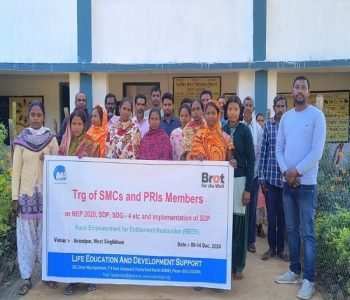
LEADS has been actively working for the effective implementation of the Right to Education (RTE) Act, 2009 in more than 2,000 government schools across Jharkhand. Since the enactment of the Act, the organization has partnered with schools, communities, School Management Committees (SMCs), government departments, and civil society organizations to ensure that every child has access to free, equitable, and quality elementary education. Through community participation and institutional strengthening, LEADS has developed several successful models for implementing the provisions of the RTE Act at the grassroots level. One of the major achievements of the programme has been the enrolment of more than 2,000 out-of-school and dropout children into formal education, ensuring that they receive opportunities for continuous learning and development. LEADS has also strengthened the capacities of over 1,200 School Management Committees (SMCs) by providing training on their roles and responsibilities, school governance, community participation, and the preparation and implementation of School Development Plans (SDPs). These efforts have enabled communities to actively participate in improving school infrastructure, teaching quality, and student outcomes. To create a child-friendly learning environment, LEADS has promoted nutrition gardens within school campuses, encouraging healthy eating habits and environmental awareness among students. The organization has also planted more than 8,000 fruit-bearing trees in schools with boundary walls and promoted live fencing in schools lacking permanent boundaries. In remote tribal villages facing teacher shortages, LEADS has provided temporary teaching support to ensure that children’s education is not disrupted. Through these interventions, LEADS has directly reached more than one lakh children studying in government schools across its intervention areas. In collaboration with the Jharkhand Right to Education Forum and other state-level networks, the organization has contributed to educational initiatives benefiting over ten lakh children across the state. By promoting community ownership, strengthening school governance, and supporting the effective implementation of the RTE Act, LEADS continues to improve learning outcomes, school management, and access to quality education for every child.
Promotion of School Development Plan and Creation of RTE-Compliant Model Schools
LEADS has been a pioneer in promoting the effective implementation of the Right to Education (RTE) Act, 2009 by actively involving School Management Committees (SMCs) in the preparation and implementation of School Development Plans (SDPs). This participatory approach has been successfully implemented in more than 2,000 government schools across Jharkhand, both directly and in partnership with organizations working in the education sector. Through School Development Plans, schools identify their infrastructure, academic, and resource needs, enabling communities and local institutions to participate in planning, budgeting, implementation, monitoring, and continuous improvement. This process has strengthened community ownership, accountability, and the creation of child-friendly, inclusive, and quality learning environments. To further strengthen elementary education, LEADS has developed the LAMPS (Learning and Monitoring Process for Schools) Model, a comprehensive framework that aligns with the RTE Act 2009, Sustainable Development Goal 4 (Quality Education), the National Education Policy (NEP), and the Samagra Shiksha programme. The model focuses on the holistic development of children by integrating child-centric, teacher-centric, community-centric, infrastructure-centric, and stakeholder-centric approaches. It promotes joyful and inclusive learning through activity-based pedagogy, local context-based teaching methods, extracurricular activities, and continuous assessment of learning outcomes. Teachers receive regular capacity-building support to strengthen classroom practices, while School Management Committees, Gram Sabhas, Panchayati Raj Institutions, Bal Sansad, and parents actively participate in school governance and monitoring. The model also emphasizes the development of safe and functional school infrastructure and the use of digital tools such as AKVO, tablets, computers, internet connectivity, and digital classrooms to enhance teaching, learning, monitoring, and overall educational outcomes. Through the LAMPS Model, LEADS is creating sustainable, inclusive, and RTE-compliant model schools that ensure quality education for every child.